Average Reviews:

(More customer reviews)Are you looking to buy D-Link DI-624S Wireless Router w/ 2 USB Port, 802.11g, 108Mbps, 4 LAN Ports? Here is the right place to find the great deals. we can offer discounts of up to 90% on D-Link DI-624S Wireless Router w/ 2 USB Port, 802.11g, 108Mbps, 4 LAN Ports. Check out the link below:
>> Click Here to See Compare Prices and Get the Best Offers
D-Link DI-624S Wireless Router w/ 2 USB Port, 802.11g, 108Mbps, 4 LAN Ports Review
(review upated 12/28/05)I would lower my rating to two or one star, but Amazon doesn't allow this.
As other reviewers found, this product has a lot of promise, but it's got a long way to go before I give it a 5-star rating.
On the plus side, I was able to share FAT16, FAT32 and Linux ext2 partitions. This last will be critical for me, because I have files too large for FAT32 (they're video, of course), and NTFS is apparently still read-only (it's apparently RO on D-Link's other storage access products, too, like the DNS-120). I haven't yet tried to write and read a fairly large file (>2GB) to an ext2 partition, but may update this review if there's anything interesting to report (such as it doesn't work).
I've so far run into a couple of challenges. One that I managed to solve was figuring out how to map the share on a Windows box. The DI-624S shares the disks via SMB (which is what Windows networking uses, but Mac and Linux can access it, too). Since the router doesn't export a windows networking name, you have to access it by its IP address, and, depending on how your PC's network is configured, you might not be able to browse its shares, even if you know the IP address. But here's the secret: the shares (if you share an ext2 partition or the entire disk) are named DI-624S_USB1 and DI-624S_USB2. So you would map (for example): \\192.168.1.1\DI-624S_USB1 . I believe the shares get named for specific folders on a FAT partition if you choose to share by folders, as opposed to the entire partition. It would be a useful enhancement if they would allow a way to set the computer name, and then advertise that using the standard Windows Networking protocol.
Update: the router is visible as a computer named "DI-624S", so you should be able to map it that way instead of using the IP addess. However, it seems that the server is only visible on the wireless LAN; computers plugged into the local ethernet LAN ports can't access the shares! At least that's what I've been finding.
On Mac OS X, mapping the drives is simpler, because you can browse the box using Connect To Server, specifying smb://192.168.1.1 (or whatever you configured its LAN IP address to be). You will see all of the shares and can choose which ones to mount. As I said, this might be possible from a Windows system, but I didn't get it to work. There doesn't seem to be any windows-style password access control on the shares.
[Update: the following problem was solved: when using encryption, some cards require Shared Key.]
Another problem I've had, which I expect I'll eventually resolve (but don't yet know how) is that while I can access the wireless LAN from Apple Airport cards, a Netgear 802.11b PCMCIA card, and the built-in WiFi on a Compaq evo notebook, I so far have had no luck with a U.S. Robotics 5430 game adapter/bridge, even though this can access an Apple Airport hub (and whatever the hubs my neighbors are using :-) with no problem. This is using WEP 64-bit encryption (on both the Airport hub and the DI-624S). It may be due to a 802.11g incompatibility of some sort, but at this point I don't know.
Another complaint is that the router only sees the first partition on the disk. This isn't a major problem for me - I'll just create one large ext2 partition. But it could be a problem if you can't use ext2 and have to use FAT32, because "the maximum FAT32 volume size that Windows XP Professional can format is 32 GB" (quoted verbatim from the Microsoft web site - you can format larger FAT32 partitions with other partition tools, though). Also, if you're a Mac user, you may need the less restrictive filenames of ext2.
[Update on performance described below: performance is basically unacceptable for any serious amount of data transfer, being limited to about 10Mbps - the speed of USB 1.1]
Performance was "interesting". While the performance of the wireless networking seemed very good, there must be something like a 5MB internal buffer - and a "do only one thing at a time" data transfer algorithm: while writing a large file, the network would flash for a few seconds, then the disk would work for a few seconds, then the network, etc. This happened in 5MB chunks. I have no idea why it can't do these concurrently, but it clearly limits the throughput to the disk. Naturally, you're not going to get full USB 2.0 bandwidth to the drive, because your network to the router is at most 108Mbps (or 100Mbps if you're coming in through a 100baseT ethernet port). But it seemed to me that you can't even get that level of bandwidth with the network-then-disk data transfer algorithm. I wouldn't have thought Linux had that restriction, but I don't really have any idea what's going on inside the box. In any case, you may not be able to stream video from this box (but I wasn't planning on that). However it did stream AC3 audio with no problem.
Another point: you should not count on this box to be an "industrial strength" Network Attached Storage server. I strongly suspect that the DI-624S doesn't support the journaling of the ext3 file system, but I haven't tried to format a partition as ext3, so I don't know. It can't do RAID (which you can easily do if you dedicate a cheap Mac or Linux box to being a storage server). And, given the fact that this product is essentially in beta test, I would not count on it to be immune to wrecking your partition map and/or otherwise corrupting your data - at least until we've had a lot more experience with it. In short, this is probably not an ideal backup storage server. Also, as a network storage server, it doesn't appear to have an FTP server, or an HTTP server for web-mapped drives. And of course it doesn't export NFS mount points (although I believe the OS on the box is Linux) - at least that's not advertised in the functionality, and I didn't try it (but who knows ...).
As other folks have said, it would be nice if they could improve the documentation, as well as add some functionality (ability to set computer name, support other protocols, see all partitions, RW access to NTFS, etc.).
[Update to above: you can, in fact, set a user password, but that's about as much security as you can do. Also, I haven't found a way to share the disks out onto the WAN, which would be useful if you wanted to access your storage from the public internet.]
[Update to below: I have now run into some of the bugs others have reported. The inability to "see" the disks from the wired LAN ports is a serious restriction, making the LAN ports virtually useless, except as normal router ports. Other bugs include frequent reboots when computers with wireless cards come online and try to connect, crashes when configuring, etc.]
I haven't hit any of the nasty bugs people have reported. I'm inclined to think these may be inability to get things to work as opposed to HW defects (at least I hope so), but I'm not ready to conclude that, yet, which would mean the box may have some reliability problems - I just haven't seen them, yet (but the night is young :-). I did have the box freeze once or twice during configuration operations, but (sad to say) that's not too unusual in consumer-grade networking products (and even with Cisco and 3-COM ...).
I recommend that before you take the plunge and get a DI-624S, do some research on D-Link's other network storage products. The DNS-120 and DNS-G120 both provide network access to USB drives, but no routing. These also (if I read the specs right) have built-in FTP servers, which can be handy. But they have some limitations, too. D-Link also has a network disk with a 40GB drive built in. And there are similar products from Tritton (e.g., the TRI-NSS250) at reasonable prices that have more NAS-type functionality than the primitive capabilities of the DI-624S.
So the bottom line seems to be: it works well enough for some purposes. It's a decent wireless hub (my USRobotics issue notwithstanding), and it may do the storage job for you. But this product is not ready for prime time, whether in the feature set, the maturity of the firmware and docs, or the difficulty of getting things working. You should be a reasonably proficient geek before attempting to use this as a storage router, and even then, don't expect a full-featured device for that purpose. The price is clearly its strongest point. I haven't needed to call on their customer support, yet, but based on other comments, I hope I don't have to.
Happy dweebing.
+++++++++++
Update: I got the USRobotics bridge working - it turned out that I had set the wireless authentication on the DI-624S to "shared key" because the Netgear card would only talk to it that way, but had left the corresponding setting on the USR bridge to "open system". Setting everything to "shared key" made everything work.
Also, you can create and share ext2 folders, and the share name is the folder name. Sure wish the doc was more detailed on all of this!
+++
Latest update (12/28/05): in all honesty, I can no longer recommend this product unless you just want to play around with a relatively inexpensive storage router. Its shortcomings in reliability, functionality, and performance don't quite even justify its low price, and support is still very poor (almost nobody you're likely to get on the phone at D-Link knows enough about this router to be able to help without at least one or maybe two escalations). On one occasion, I specifically asked if a firmware upgrade was in the works, and was told there's nothing current, though that doesn't mean there won't be something. But I'm beginning to wonder if D-Link isn't planning to drop this product soon ... If you need a real network storage server, I have to recommend shopping elsewhere. But if you're a geek who doesn't mind a little challenge for modest functionality at a good price, give it a try.
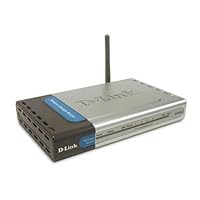
D-Link DI-624S Wireless Router w/ 2 USB Port, 802.11g, 108Mbps, 4 LAN Ports Overview
The DI-624S creates an 802.11g wireless network and shares a single broadband Internet connection throughout your home or office. This router also features two USB ports to allow users to attach and share USB hard drives on your network for accessing saved media files. Use this device to share both Internet access and extra storage drives. For computers running Windows XP Service Pack 2, you can take advantage of Windows Connect Now to simplify the configuration of your wireless settings. Take advantge of the advanced parental control features to block inappropriate content and keep members of your family safe.Want to learn more information about D-Link DI-624S Wireless Router w/ 2 USB Port, 802.11g, 108Mbps, 4 LAN Ports?
>> Click Here to See All Customer Reviews & Ratings Now

0 comments:
Post a Comment